
Views & Reflections
A curated conversation with Mary Berry
Executive Director, The Berry Center
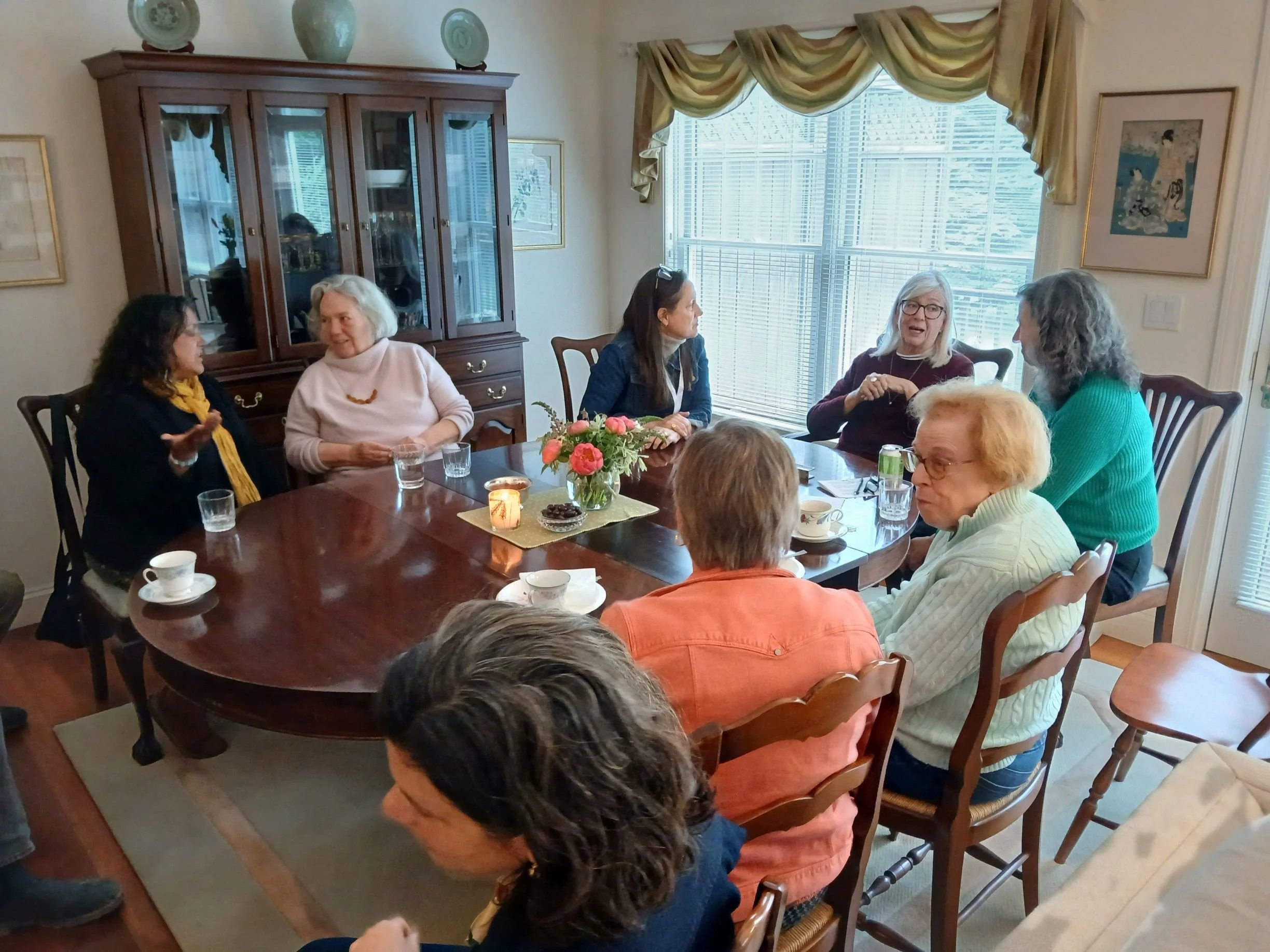
BAV hosted a small gathering in May, 2026, to share conversation and ideas with Mary Berry, Executive Director of The Berry Center, a Kentucky-based nonprofit she founded in 2011 to put her father Wendell Berry’s writings to work by advocating for small farmers, land-conserving communities, and healthy regional economies. We are pleased to share an edited and condensed version of our conversation here.
Can you share some reflections on your upbringing?
I’m very lucky to have been born to the parents I was born to. I don’t remember ever wanting to live anywhere other than Henry County, Kentucky. For about ten years, I did not choose to live this way and I told my parents, “I don’t understand why we have to do everything the hardest way possible.” But I never thought they were really wrong about anything — and that is the truth!
I was raised with an agrarian vision and all I had to do was accept it. Part of what we need to talk about is vision. In Kentucky, there are an awful lot of people trying to do good things, but if you don’t have a vision based on something, you’ll fall for anything. And I think that’s been a weakness of [the local food] movement. Maybe that’s part of the reason there hasn’t been cultural change.
Can you tell us about your family’s work on the Burley Tobacco Growers Cooperative as a model for The Berry Center’s local meat program, Our Home Place Meat?
I grew up in a place that had a pretty intact agricultural community. We had a culture of raising tobacco. What we didn’t have was an economy that brought stability to that. It was my great-grandfather’s sale of his tobacco crop that started my family’s public life.
My grandfather [the late John M. Berry, Sr.] came home after the sale of his 1906 crop with nothing. After he paid the warehouse fees, there was nothing left. That’s been the story of agriculture in this country. He said to himself, if I can do something about this, I will. He would tell stories of men leaving the warehouses with tears running down their faces. He grew up and did do something about this.
He wrote the legislation that became the Burley Tobacco Growers Cooperative, and it worked for over sixty years to bring stability to the people it was meant to work for — small to mid-sized family farmers in Kentucky. I have taken the principles of that program — I’m not expecting any federal help here! — which are “production control in order to maintain parity pricing,” and I’ve used that for the cattle farmers we work with today. And it’s worked.
My grandfather says in his papers that “production control in order to maintain parity pricing” could and should work for anything farmers could produce — from timber to tobacco.
What have you learned from working with the farmers in Our Home Place Meat?
I’ve learned so much from Our Home Place Meat. My husband [Steve Smith] says that with just a little help, people and land can heal. I have seen that with these young farmers. The lovely thing is they’ve started to think. I am not insulting my people, but if you’re a “price taker” for too long and if quality doesn’t pay, you stop thinking. If you also have to have a full time job in order to farm, you just don’t have time.
So they’re thinking again, talking to each other again. What I’ve seen is a healing of a community that’s been coming apart since the end of the tobacco program — a mending itself back together. I wouldn’t have bet a quarter that that would happen as fast as it has.
There are challenges weekly. The biggest challenge right now is a sky-high cattle market. Our farmers have stuck with us. They’re thinking long term — another thing farmers haven’t done for a while. They know that prices will come down and we’ll be here when they come down.
The Covid challenge actually was an opportunity. For instance, we got meat to people who needed it quickly and easily when it couldn’t be found. I recently wrote an open letter with the mayor of Louisville in mind. I said this is what we’ve been talking about: If you take care of farmers in good times, they’re here in bad times. And you have access to food.
Can you share more about the strengths and limitations of the local food movement? How can we truly help farmers?
My husband and I both benefited from the local food movement. He started the first CSA in Kentucky — after calling Robyn Van En at Indian Line Farm in Great Barrington. We were the first farm in Kentucky to offer pastured poultry, which we processed ourselves in our former dairy. We raised organic vegetables; we had the first organic beef herd in Kentucky. We did everything we could think of to keep farming without tobacco. We succeeded.
But my husband and I talk often about the fact that in those years when we were doing the entrepreneurial work, we thought we were heading to a local food system. It was a realization that in Kentucky in 2009, we were no closer to a local food system than we had been in 1985.
I finally realized one day that the cavalry ain’t coming. We’re going to have to do this ourselves. Our Home Place Meat is our first effort to put something between the farmer and the marketplace to take care of pricing, marketing, and distribution.
In this country, we have large and industrial farming and we have small and entrepreneurial farming, and we have almost nothing in the middle. I think those of us who care so much have got to begin to look for examples and try to put something in place that allows farmers to farm — if we value them.
I think we’ve got to see that the local food movement has stalled out and it’s stalled at entrepreneurial farming. It’s good and should be supported, but it’s not enough. It’s not keeping up with rural decline and it’s not changing the culture of agriculture.
I’ve learned this from my father, along with several other things: You start good work with an inventory of what you have to work with. This is another weakness of the local food movement — it’s been top down and though good and well-intentioned, it’s not coming down far enough. We need to put infrastructure in place.
What is the role of policy for supporting farmers and our food system?
I was uninterested and unwilling to work on policy when I started The Berry Center [in 2011] because with all those decades of farming and farm efforts, we had educated the consumer until I was tired of educating the consumer. Farmers can’t educate the consumer!
I had met with and heard from people working on policy, but everything was getting worse. So I felt that somebody has got to put something in place for existing farmers — just do it.
Fifteen years later, I’m now kind of interested in policy. I think we have enough time and experience under us to begin to think about regional food economies and what kind of policy is needed. Then reconcile ourselves to the long haul. Cultural change is the long haul.
What do we lose when we lose smaller-scale farmers?
I don’t think people — people who care — understand what we’ve lost. How many farmers have been lost, and how losing the farmers has meant we’ve lost the culture of agriculture. Which my father says in The Unsettling of America: Culture and Agriculture turns out to be indispensable. The culture of agriculture makes sure the correct work is done, the knowledge is handed down. We have to acknowledge the truth about where we are — and go to work.
Can you say more about the role of consumer education?
We have to stop waiting for consumers to be educated and start doing what we need to do to get good food onto shelves. And we’ve got to think about mid-sized farmers. We have got to hold onto what we’ve got.
Every farm family in Our Home Place Meat Program has bought a farm, not inherited it. Before Covid, you could buy farmland for $3-4,000 per acre in Kentucky; after Covid, that’s doubled.
That’s part of the inventory: what do we have to work with that’s already here that’s working?
The most important thing to me is that we stop waiting for consumers. Consumers did get educated to a point and pushed for organics — and then we had industrial organics that could move a lot faster than farmers could.
We have to make sure that the people doing [the work of farming] can keep doing it.
What is the role of nonprofits in supporting farmers?
I didn’t start The Berry Center because I’d been dying to start a nonprofit. Fifteen years later, I now think — who else is going to do this work? The government?
We are also teaching the great agrarian legacy of literature that my father belongs to. It’s so important now more than ever — people need that. I grew up in a culture that supported me as a young farmer. These young people now are often farming alone.
What advice do you offer farmers and where do you find hope?
[Young farmers] have to think about expectations. I tell students — if you want to farm, then your joy is going to need to be your work. You’re not going to have vacations with pay. I think we’re not thinking about limits as such.
Rural America has been treated as a sacrifice zone and it’s been by design. So we need a different design. I find that hopeful. We had a better design not that long ago — in my father’s lifetime. A young farmer in Kentucky could buy a farm and make a living on it. That hope has lived and died in one lifetime.
Thank you so much for these reflections!